

If you’ve been wondering whether your business really needs a mobile app, here’s the short answer: yes—and sooner than you think.
We’re living in a mobile-first world. Over 54% of internet traffic comes from mobile devices, and people spend nearly three hours a day inside apps, according to the published statistics on Statista. That means if your business isn’t showing up on mobile, it’s practically invisible to the very customers you’re trying to reach.
For years, small businesses assumed mobile apps were only for big corporations with massive budgets. But times have changed. In fact, nearly half of SMBs report getting a 10x return on investment (ROI) from their apps. More and more entrepreneurs are using mobile apps to grow, connect with customers, and run their operations more efficiently.
So, let’s dig in. Why exactly should you consider building an app for your business? And how can you make it affordable and practical?

Key Takeaways
- Mobile apps are not just for big corporations — small and medium businesses are seeing massive ROI.
- Customers prefer apps over websites: 88% of mobile time is spent inside apps.
Apps boost loyalty and engagement through push notifications, rewards, and personalization. - Development is more affordable than ever — with MVPs, cross-platform builds, and templates.
- Apps future-proof your business by enabling AI, AR, IoT, and emerging tech integrations.
Why Apps Are No Longer Optional
Think about your own behavior. When was the last time you visited a company’s website on your phone instead of opening their app? Probably a while ago. That’s because apps offer speed, convenience, and personalization that mobile websites simply can’t match.
The Consumer Behavior Transformation
- 88% of mobile time is spent in apps, not browsers.
- Nearly half of people check apps 11+ times per day.
- Shoppers spend 201 minutes per month in e-commerce apps, compared to just 10 minutes on mobile websites.
- 18% of local smartphone searches lead to same-day purchases.
Customers have already made apps part of their daily routine. If your business isn’t part of that routine, you’re missing out.
The Business Imperative
The pandemic rapid mobile adoption by over 25% worldwide. Businesses that adapted quickly by launching apps thrived, while others lost ground to competitors. Having an app is no longer about staying trendy—it’s about staying in business.
Industry-Wide Adoption Patterns
From retail to restaurants, apps have become the norm:
- Retail: 89% of mobile shopping happens in apps.
- Finance: Banking apps see 3x more engagement than websites.
- Healthcare: Telemedicine apps exploded with a 3,800% usage spike during 2020–21.
- Food & Beverage: Quick-service restaurants report 30% higher revenues from app-based ordering.
For businesses wondering about development costs and choosing the right partner, understanding how to choose a web development company provides crucial insights for making informed decisions.
Quantifiable Benefits: The ROI Reality for Modern Businesses
One of the biggest misconceptions is that apps are expensive without a guaranteed payoff. But the numbers tell a different story.
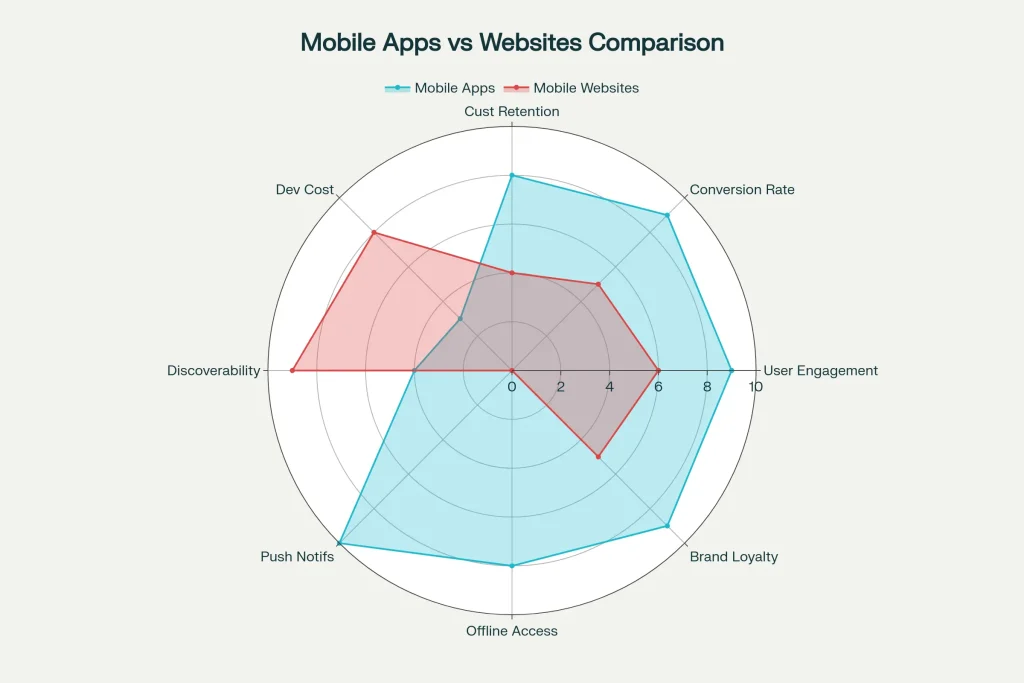
Revenue Impact & Conversions
- Mobile apps convert 3x more than mobile websites.
- Returning app users spend 67% more than first-time visitors.
- Mobile-first businesses enjoy 15% higher conversions overall.
- Global mobile commerce is projected to reach $935 billion in 2024.
That’s not just growth—it’s a massive opportunity waiting to be tapped.
Customer Retention and Loyalty
Acquiring customers is hard. Keeping them is even harder. Apps make it easier:
- A 5% increase in retention can boost profits by 25–95%.
- Push notifications reduce app abandonment by 16%.
- Businesses report 30–70% growth after launching an app.
- Apps keep your brand visible 24/7 on your customer’s phone.
Operational Efficiency
Apps aren’t just for your customers—they make your business run smoother too. They can:
- Automate routine tasks to reduce overhead.
- Provide real-time analytics to guide decisions.
- Cut customer service costs with in-app communication.
- Improve inventory and workflow management.
How Mobile Apps Enhance Customer Experience
Here’s where apps really shine. They deliver a level of personalization and convenience that websites can’t compete with.
Personalization and Customization
Modern apps can adapt to your customers’ needs:
- Personalized recommendations based on purchase history.
- Location-based offers and services.
- Dynamic content that changes with user behavior.
This isn’t just nice to have—it builds loyalty.
Push Notification Capabilities
Push notifications are game changers:
- Send real-time updates on orders, promotions, or appointments.
- Re-engage inactive users with special offers.
- Target customers based on their behavior or demographics.
It’s like having a direct line of communication with your customers—without fighting for attention in their inbox.
Offline Functionality
Unlike websites, apps don’t stop working without Wi-Fi:
- Cached content allows offline browsing.
- Some apps support offline transactions.
- Data syncs automatically once the device reconnects.
That means your customers can interact with your brand anytime, anywhere.
Social Integration Features
Apps also make it easy for customers to:
- Share products or services on social media.
- Post reviews or photos directly through the app.
- Sign up quickly with social login options.
- Join communities that strengthen loyalty.
Making Mobile Apps Affordable for SMBs
Here’s the part most small business owners worry about—the cost. But the good news is, app development is no longer reserved for companies with six-figure budgets.

Typical Development Costs
Modern mobile app development offers flexible investment options based on business requirements and complexity levels:
- Basic apps ($10K–$35K): User accounts, simple features, clean design.
- Moderate ($35K–$80K): Payments, push notifications, custom UI.
- Advanced ($80K–$250K): AI-driven features, enterprise-level integrations.
- Maintenance: Usually 15–20% annually for hosting, updates, and support.
Cost-Saving Strategies
Smart development approaches can significantly reduce initial investment requirements while maintaining quality:
- Start with an MVP (Minimum Viable Product). Build core features first, then add more later.
- Use cross-platform development to build once for iOS and Android.
- Roll out features in phases to spread out costs.
- Leverage templates and frameworks for common features.
Long-Term Value Proposition
Think of an app as an investment, not just an expense. Apps grow with your business, increase customer lifetime value, and give you a competitive edge—all while generating data you can use to improve marketing and sales.
For businesses considering the financial aspects of digital transformation, understanding how much it costs to develop a web application provides valuable context for comparing mobile app investments with other technology initiatives.
Competitive advantage with mobile apps
In today’s crowded markets, an app can be the edge that sets you apart. These advantages compound over time, creating sustainable market positions.
Market Differentiation Opportunities
In increasingly competitive business environments, mobile apps offer unique differentiation possibilities:
- Be the first mover in your niche or location.
- Deliver better service than competitors without apps.
- Build loyalty with consistent app interactions.
- Show innovation that customers notice.
Customer Data and Analytics
Apps give you access to data that websites can’t match:
- Behavioral analytics to understand how customers shop.
- Demographic insights for targeted marketing.
- Real-time engagement metrics.
- Predictive analytics to forecast trends.
Market Expansion & New Revenue Streams
With an app, your business can:
- Expand into new markets without physical presence.
- Operate 24/7 without extra staffing.
- Unlock revenue through subscriptions, ads, or in-app purchases.
- Create partnerships and integrations that add value.
Future-Proofing Your Business with Mobile Technology
Technology isn’t slowing down—and neither are customer expectations. Apps position you to take advantage of what’s coming next.
AI & Machine Learning
- Smart chatbots for instant support.
- Predictive analytics for customer behavior.
- Personalized recommendations in real-time.
Augmented Reality (AR)
- Virtual try-ons for retail.
- Interactive product demos.
- Immersive brand experiences.
Internet of Things (IoT)
- Smart device connectivity.
- Automated workflows.
- Richer data collection.
Voice & Emerging Tech
- Hands-free controls for accessibility.
- Voice search capabilities.
- Seamless cross-device integration.
By laying the groundwork now, you’ll be ready to adapt to 5G, PWAs, and the next wave of mobile innovation.
Frequently Asked Questions
How long does mobile app development typically take?
Development timelines vary based on complexity, ranging from 3-6 months for basic apps to 8-12 months for advanced solutions with complex integrations and custom features.
Can small businesses afford mobile app development?
Absolutely. Basic functionality apps start at $10,000, and 49% of SMBs report achieving 10x or higher ROI, making apps financially viable for businesses of all sizes.
Should we develop for iOS, Android, or both platforms?
Cross-platform development allows single codebase deployment to both platforms, reducing costs while maximizing market reach. Platform choice should align with target audience preferences and business objectives.
How do mobile apps compare to mobile-optimized websites?
Apps provide 3x higher conversion rates, superior user engagement (201.8 vs 10.9 minutes monthly), push notification capabilities, offline functionality, and deeper customer data collection compared to mobile websites.
What ongoing costs are associated with mobile apps?
Maintenance costs typically range from 15-20% of initial development costs annually, covering updates, hosting, security patches, and technical support.
How can businesses measure mobile app ROI?
Key metrics include customer acquisition cost, lifetime value increases, conversion rate improvements, engagement metrics, retention rates, and direct revenue attribution through app-specific transactions and interactions.
Conclusion
The mobile app revolution is here, The numbers don’t lie:
- 49% of SMBs achieve 10x+ ROI from their apps.
- Apps deliver 3x higher conversions than mobile sites.
- Mobile devices now account for 54.4% of internet traffic.
What was once a luxury for big brands is now an essential growth tool for every business.
The only real question left is: how soon can you launch your app before competitors leave you behind
The mobile revolution is here. Don’t wait—the time to act is now.

Written by,
Anand D.With 16 years of experience, Anand leads sales and business growth with a strategic mindset and a passion for results. He specializes in turning ambitious ideas into actionable plans, empowering businesses to scale efficiently and confidently.

Got a project? Let’s talk.


