The cost of developing a web application isn’t as straightforward as many assume.
Most people Google “how much does it cost to build a web application” expecting a flat number—but the reality?
It depends on who you build with, what you make, and how it needs to function at scale.
In this detailed guide, we break down the real cost of web application development using real case studies from clients in the USA across industries like healthcare, fintech, ecommerce, and logistics. We’ll show you how features, design, compliance, and industry challenges all affect pricing—and how to budget smarter.
Key Takeaways
- Web app development costs range from $10,000 to $250,000+, depending on complexity.
- Costs are influenced by factors like features, tech stack, design, and industry regulations.
- Different industries (like fintech and healthcare) have different compliance needs, impacting cost.
- Real case studies from iGex clients offer transparent pricing insights.
Many businesses underestimate hidden costs like infrastructure, third-party tools, and updates.
What is the average cost of developing a web application?
When estimating the average cost of developing a web application, it’s important to consider a wide range of project types. The average cost to develop a web application varies in factors like the project’s complexity, industry-specific requirements, and chosen tech stack all play a role.
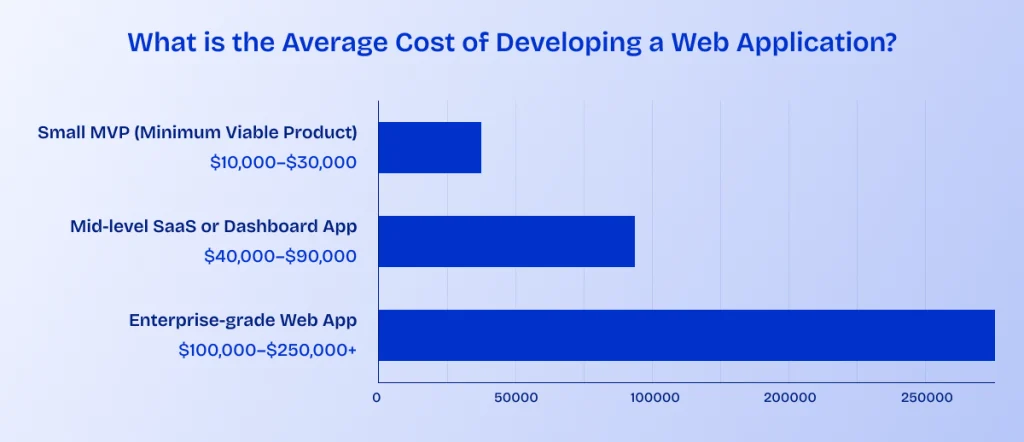
For an example:
- Small MVP (Minimum Viable Product): $10,000–$30,000
- Mid-level SaaS or Dashboard App: $40,000–$90,000
- Enterprise-grade Web App: $100,000–$250,000+
These numbers aren’t random guesses—they’re based on real elements like design complexity, backend systems, integrations, and long-term scalability. Keep in mind that quality matters: lower costs often mean trade-offs in security, stability, and UX.
Most startups and SMBs hope to build a web app with a small budget. And while it’s technically possible, the true cost lies in what you need the app to do.
For example, a simple appointment booking app is far cheaper than a multi-tenant fintech platform with payment integrations and security layers like PCI-DSS compliance.
Companies that partner with iGex Solutions get a detailed cost map early in the process to avoid budget surprises down the road.
At iGex Solutions, we ensure clients understand not just what they’ll spend but why—backing our estimates with data and transparent communication.
We encourage every business to do their research and compare estimates with agencies’ past work and client success stories.
If you’re currently searching for a dev partner, it’s crucial to understand not only pricing but also how to choose a web development company—especially before committing a serious budget.
Key cost variables most companies overlook
There are many articles out there stating how much it costs to make a web app—but very few mention that building a web app goes beyond writing code.
You might budget for a few developers and assume it covers everything, but web application development also involves;
- UX/UI Design
- Database architecture & scalability
- API & third-party tool integration
- Compliance (e.g., HIPAA, GDPR, PCI-DSS)
- Hosting and DevOps
- Ongoing maintenance & updates
The biggest budget killer isn’t usually features—it’s what you forgot to include.
Custom web applications often need external APIs, robust cloud architecture (like AWS), or analytics dashboards.
And if you’re in a sensitive industry (like healthcare or fintech), expect a 25–30% budget increase just to ensure compliance.
This is where many “cheap” dev agencies fall short—they leave these essentials out of the quote, leading to overages later.At iGex Solutions, we include all required components in your cost estimate from the beginning.
Breaking down the cost by project phase
Every successful web app goes through multiple phases—and each stage has its own cost structure.
| Phase | Description | % of Total Budget |
| Discovery & Strategy | Requirements gathering, planning | 10-15% |
| UI/UX Design | Wire frames, Prototyping | 15-20% |
| Development (front + Back) | Core feature buildbot | 40-50% |
| QA/ Testing | Functional, security, usability testing | 10-15% |
| Deployment | Hosting, setup, go-live | 5% |
| Maintenance | Ongoing supports and upgrades. | 10-15% |
Each phase is important—and skipping any stage can lead to bugs, delays, or cost overruns.
For instance, design mistakes in the wire frame stage can cascade into major rework during development. This is why at iGex we follow an agile development model, keeping our clients informed and involved at every phase.
Let’s talk about your web app goals. We’ll walk you through cost estimates, timelines, and the best tech for your industry.
Book a time that works for youThe iGex solutions approach: Transparent costing from day one
Many agencies throw a number at you with explanations. At iGex Solutions, we do things differently.
Our approach :
- In-depth requirement analysis
- Tech stack recommendation (React, Angular, Laravel, etc.)
- Industry-based feature checklist
- Transparent time & cost estimation
By doing this, we reduce miscommunication and prevent budget overruns. Unlike freelance developers or generic web development agencies, our team aligns costs based on real-world tech costs, not wishful thinking.
For example, if you’re unsure what you really need for your app, we’ll help you separate “nice-to-haves” from “mission-critical” features.And if you’re a startup? We help you launch with a lean MVP, while ensuring it’s scalable.
Why most development estimates are inaccurate
Many businesses use online cost calculators or rough hourly quotes without considering the full scope—and end up underestimating by 30–60%
Agencies may leave out things like hosting costs, cloud scaling charges, security hardening, or integration testing—only to surprise you with these “extras” after the project kicks off.
A $10K quote might seem tempting—but if it doesn’t scale, breaks under traffic, or requires rebuilding?
The truth is, lack of planning is often more expensive than the initial quote itself. That’s the reason smart businesses budget for quality, not just delivery.
At iGex Solutions, our estimates are built from;
- Requirements-first discovery model
- Ensuring that every technical
- Security, and compliance consideration
We help clients to avoid hidden surprises by providing clear deliverables and milestone-based costing, ensuring your project remains transparent and under control.
Web application development costs by industry (What really changes?)
Not all industries are created equal—especially when it comes to developing a web app.
A generic blog platform won’t need the same features or regulatory compliance as a fintech dashboard or a healthcare patient portal. Industry-based requirements like HIPAA in healthcare, PCI-DSS in fintech, or learning analytics in EdTech add layers of testing, infrastructure, and design that most early-stage businesses don’t plan for.
This is why iGex always starts with an industry-specific feature checklist. By understanding your vertical’s real needs, we prevent scope creep and budget blowouts.
Below is a breakdown of how the cost of developing a web application varies based on industry.
Healthcare web app development cost
- HIPAA Compliance
- Secure Patient Portals
- EHR/EMR Integration
- Data Encryption
- Cost: $60,000–$250,000+
Fintech web app development cost
- PCI-DSS Compliance
- Real-time Transactions
- Two-Factor Authentication
- Fraud Detection
- Cost: $100,000–$300,000
Ecommerce web app development cost
- Shopping Cart Systems
- Stripe/PayPal Integration
- Real-Time Inventory
- Loyalty Programs
- Cost: $40,000–$150,000
Education sector web app development cost
- Role-based Dashboards
- Gamification
- Video Streaming (WebRTC)
- Analytics and Quizzes
- Cost: $30,000–$120,000
Logistics web app development cost
- Fleet Tracking
- Google Maps Integration
- Route Optimization
- Real-Time Sync
- Cost: $50,000–$140,000
Hidden costs clients discover too late
Even the most detail-focused clients are often surprised by hidden costs during or after development. These includes;
- API Licenses
- Hosting and Scaling
- Maintenance Contracts
- Security Audits
- DevOps Infrastructure
Total cost of ownership includes all the above.
At iGex, we help clients plan beyond launch—into growth and uptime. For us transparency isn’t optional—it’s a must.
FAQs
How much does it cost to develop a web application?
Costs of a web application depends upon the features, complexity of the app, compliance needs. Development cost typically starts between $10K to $250K. This cost features such as real-time updates, data storage in the cloud, strong security, design requirements, etc.
Is it cheaper to build a web application with freelancers or an agency?
Choosing between a web development agency and freelancers mainly depends on your needs, budget, project timeline and personal decision. Hiring a freelancer for a project is often a more cost-effective way compared to agencies but in general freelancers can be risky for complex projects or you’re running with deadlines as there is no easy way to confirm that either he is actually doing the project or outsourcing it. If they ghost you how long you can wait for them to come back. For important or complex projects, web development agencies are more reliable than freelancers.
How much do you charge to develop a web application?
There is no blanket answer to these questions, as the cost of developing a web app will vary depending on requirements and how complex the project is. However, if you’re planning to hire iGex solutions as your web development partner, you can hire us on a fixed project or per hours basis as well.
What’s the difference between upfront development cost and long-term app cost?
Upfront costs cover design and build; long-term costs include hosting, updates, maintenance, and security. Both should be budgeted from the start.
How long does it take to develop a web application?
The time it takes to complete a web application can vary based on various factors . For example, a small MVP might take 4 to 6 weeks, while a more advanced web platform could require 4 to 6 months. The timeline depends on your feature list, tech stack, integrations, team size, and review cycles.

Written by,
Vishal BhattWith 18+ years in mobile technology and business strategy, Vishal drives innovation and growth at iGex. He shares sharp insights on startups, emerging tech trends, and smart scaling tactics for modern businesses.

Got a project? Let’s talk.